Showing posts with label organisation. Show all posts

Monday, September 17, 2018

Report from the field: My Daily Routine

Recently, I posted about Monday tips and tricks and included John Piazza's weekly schedule. Last week, John Foulk, my colleague and friend, posted about finding support for the CI classroom.

I want to further that discussion a bit and talk about my daily schedule. I am going to skip my history with it... although, if you are interested in it you can check out our subscription service and our recent summer reflection series where I discuss in length.

My Schedule

My schedule this year is a little different in that last year and the previous year (when I started this), I had one prep. This year, as I am in charge of Latin IV (and we have 2 classes of Latin IV), I am also teaching one class of Latin II and two classes of Latin I. This has created a need (for me) for regular routine. My IVs were already used to the way I do things by now, but the IIs and Is have never had me before and so this was brand new to them (in the way that I do it). 

Daily Breakdown - ALL CLASSES

There are a few things that I do with all my classes. Variations (or lack thereof) are highlighted in orange.

Telephone Ritual

I give credit to Robert Patrick for this routine. I used to do it as needed, but now it is the first thing we do every day. In Latin, we go through where our phones should be and where they shouldn't be. Of course, this looks a little different by level:

Latin IV

These students know this by now and this serves merely as a reminder. We go through this quickly. 

Latin II

These students are used to it, but still need regular reminders. We go through it together, saying the words at the same time. 

Latin I

For these students, what I am asking is new. We go through each one and we do hand signals to show that we are ready for class. 

Date

I do the date in Latin in every class, no matter what. It is done the same way in every class, but in my lower levels I sometimes break in English to make sure we understand or to ask follow up questions. I do not do the old Roman calendar. I see its benefits, but find it more useful to my students today that they use our calendar for the date. 

I don't vary this. We do it the same way every time because I want my students to feel this routine so that when I'm not here or when we do timed writes, they can do it on their own with little thought. 

Weather

We do the weather every day in my class. Last year I did not vary how we did it, but took advantage of the.... interesting weather we had: an eclipse, a hurricane, ice, snow, etc. But, this year... things have been relatively... stagnant, with the exception of rain, so I've gotten creative. Here are some variations I've done with a brief follow up on each. 
  1. with pictures - I started this way in August for my ones, who had never done this before. This was a way to provide some circling and give them visual input. My upper level also benefited from this. Each day I added a new picture. The first day was just the sun. The second day was the sun and clouds. The third day added hot and cold. The fourth day added wind, and so on. This led into a few days of slides with just the questions, no pictures on them. 
  2. with seasons - we are smack in the middle of changing seasons. In one month, fall officially begins (yay sweater and chili season). Most of my students are tired of the heat and the humidity and are hoping for some relief. This provided an opportunity to put up the seasons and discuss them and their differences. Day 1 included the change from summer to fall. Day 2 included all four seasons and a discussion of who liked what. Day 3 (tomorrow for me) will include all four seasons and the typical weather one finds in each season. 
  3. with the world - This may be one of my favourite ways to do weather right now. Here in Georgia, we are getting two types of weather: hot and sunny... and hot and humid... It gets boring. So, I picked some other kinds of weather (tornadoes, hurricanes, snow, monsoon, flood, lightning, etc.) and we talk about where in the world those things are happening. We've talked about Hurricane Lane, snow in the mountains in South America and Europe, lightning in Germany and Italy, and dust storms in Arizona. 

Daily Breakdown - Some classes Some Days

There are a few other things I do, but they don't happen every day or in every class. I've highlighted class specifics in blue and day specifics in green. Variations appear in orange. 

Nuntium - News

I only do the news in Latin II and IV. Originally, I had only intended to do it in Latin IV, but recently I accidentally showed the IIs the slide and they got really excited.... so now we do the news in Latin II as well. We do a news item on Tuesdays, Wednesdays, and Thursdays. I choose news items that I hear on my way in on the radio or that I have heard about recently. This year alone we've talked about Hurricane Lane, a robbery of a lemonade stand in North Carolina, the fire in California, and Senator John McCain's death. Typically I will  I do it a bit differently in these classes:

  1. Latin IV - This is done entirely in Latin. I usually try to include the grammar topics we are covering as well to provide an in context example. We will discuss as needed and sometimes we get into a debate or discussion about a variety of things. 
  2. Latin II - This is done part in Latin and part in English. Mostly my goal is to get them understanding things in Latin about our current world. 

Grammar Topics

This is only in my Latin IV class. They are ready to receive a bit of explicit grammar instruction, so on Tuesdays and Thursdays, we spend about 5-10 minutes discussing a topic. Last year, students covered all the declensions of nouns and all 7 cases. We also discussed sentence structure and poetry. This year, we've covered: ablative absolutes, fear clauses, ablative of time when, accusative of duration of time, ablative of description, subjunctive uses. However I should state that all of these things are not new. We've been using them in class as needed since day 1 of Latin I. In their first week of Latin I students saw an indirect statement. In Latin II we used the ablative repeatedly (including ablative absolutes) and worked with the supine. It is a common misconception that teachers who use CI do not use/teach grammar. We use grammar every day and our students see (often considered) complex grammar structures before their traditional class counterparts, however we don't explicitly talk about it until the students are ready. 

Free Voluntary Reading

I promise I am working on a post about how I do this. In fact, it should come out some time in October! But... in the meanwhile. I do free voluntary reading across the board, however it starts at different times of the year. Once we start it, we do it every Monday, Wednesday, and Friday. I've broken down how I do it (or plan to do it) below by level. 
  1. Latin IV - These students have been doing this now for 3 years. They started reading this year in the first week. Right now (August 2018), they read on Mondays for 10 minutes, Wednesday for 12+ minutes, and on Fridays we hold a class "book club". We talk about what we are reading, what we like, and other things like this. 
  2. Latin II - these students are in their first year of FVR with me. They started reading last week. Right now (August 2018), they read on Mondays for 5 minutes, Wednesdays for 5+ minutes, and on Fridays we hold a class "book club" (see above.)
  3. Latin I - These students have not started FVR. They are still acquiring basics and I won't start FVR until probably January of next year (2019). When we start, we'll read on Mondays for 5 minutes, Wednesdays for 5+ minutes, and on Fridays we'll hold "book club" (see above). 
I posted a few weeks ago on the FVR project my IVS did. You can read it here. Be on the lookout in October for my post of posts on FVR!

Reflection

I am loving my daily routine right now. It keeps me accountable to (a) start class on time and (b) get us into the swing of Latin. Right now, my IVs are comfortable with 90%+ time in Latin. My IIs just experienced their first few days of 80%+ in Latin, and my ones are averaging about 50%+ in Latin right now. I credit this, in part, to my daily routine. It gets us speaking Latin right off the bat and sets clear expectations for class. If I don't have all the pieces ready, the kids know and they ask about it. 

This is something I will definitely continue doing and I am excited by some of the unique things my colleagues are coming up with! I'm hoping he'll post on it, but Keith has us doing things with "quot videtis" (how many do you see) and visual illusions as well as "quid hoc die accidit" what happened on this day. 

Do you have a daily routine? What is it like?

Monday, August 20, 2018

FVR - a project in three parts

I have started and deleted many a post on Free Voluntary Reading (FVR). In fact, I have a draft sitting there which goes through the last 3 years of iterations of FVR in my classroom that... one day.... I swear I'll publish. Today, however, I want to detail the project I gave my current IVs this year. I am quite impressed with how it has gone and, I'll admit, part of me wants to post this to brag on my students and how well they are able to handle things because I really am impressed. We are two weeks into the school year and my IVs keep impressing me more every day. I'm so stinking proud of them :)

Some Background

A few things you should know before I tell you what I did. 
  • My IVs started FVR in Latin II Spring semester. First they started in groups, then individually with small group discussions, and now individually with whole class discussions. 
  • We try to buy all the novellas as they come out, after the teachers read them and determine if we think our kids will like them. 
  • Right now we have a wide variety of novellas (although not all or enough in my opinion) and the list of Latin novellas is growing daily! I am so excited.

The Premise

Last year, Rachel and I did a book study on The Reading Whisperer and Readicide. You can listen to our book study and see our notes here. In May, I spoke to our team (Keith Toda, Robert Patrick, Rachel Ash, and John Foulk) about the possibility of doing a project based on The Reading Whisperer and what she does with her elementary students to get them interested in reading. I expanded it because we are reading in a second language and sometimes it can be daunting trying to figure out if a novella is (a) interesting to you and (b) appropriate for your level of proficiency. 

The Process

Desired Result

a catalog of the novellas we currently have that includes all the details a student might want to determine if this book was one they wanted to read:
  1. title + author
  2. description of cover
  3. number of pages...
    1. in the book
    2. in each chapter (average)
    3. of chapters
  4. genre
  5. details about the dictionary
    1. on the page
    2. in the back
  6. a short description in English no spoilers

A Process in 3 Parts 

We completed this process in three pieces and this took us about 7 days (15-20 min per day) over the course of 2 weeks. 

Part 1

Students worked individually for ~3 days with the novellas. They took a novella that they hadn't read in the past (ideally) and took notes on the basics of the novella (title, author, pages, etc) and then some other notes on the feel and idea of the book including the difficulty/ease of reading and notes on the dictionary.

Part 2

Students got into groups of 2-3 and worked together on the books they'd done to get all the information asked for (including the English summary) and submitted it to a survey online. Between 2 classes of Latin IV students, I got ~75 responses over the course of another ~3 days. 

Part 3

Once I got all the responses, I compiled them into lists by novella. I gave each group 2-3 novellas. Their job was to compile all the information into 1 single entry about the novella. They wrote it out and gave it to me. This took about ~30-40 minutes on 1 day. 

Follow Up

So, what am I doing with all this info? Well, a few things;

A grade

Students received a grade for the notes they took in the beginning. I looked to see whether students communicated how difficult the book was and what notes they took on the subject of the book. 

A catalog

I compiled all their notes into one single catalog. Then, we printed QR codes to go on the backs of the books and had them taped on. Now, any time a kid wants to read a book, but isn't sure what it is about, they can scan the code and get a quick view of all the details of the book. 

It's a win/win :) 

Thursday, August 11, 2016

Creating a Welcoming Classroom

This is usually me.
This is just a quick post to offer some ideas on classroom organization and design, because I have often found that I need ideas for this and have envied the beautiful classrooms I see on Pinterest and in blog posts and at elementary schools. Even when researching for ideas, the one high school classroom image I found seemed to lack something homey and welcoming that all of the elementary school rooms had. It was clean and well-organized, but somehow more bland and industrial-seeming than the others.

And I found, when setting up my room this year (I moved rooms! I have a window!), that even as I set up the room's furniture to maximize space and create a good flow for activity, the room still looked basic--it didn't look like it was "my room" or create a comfortable space where students could feel at ease.
Just your average, boring, gray metal
bookcase with all the shelves removed.
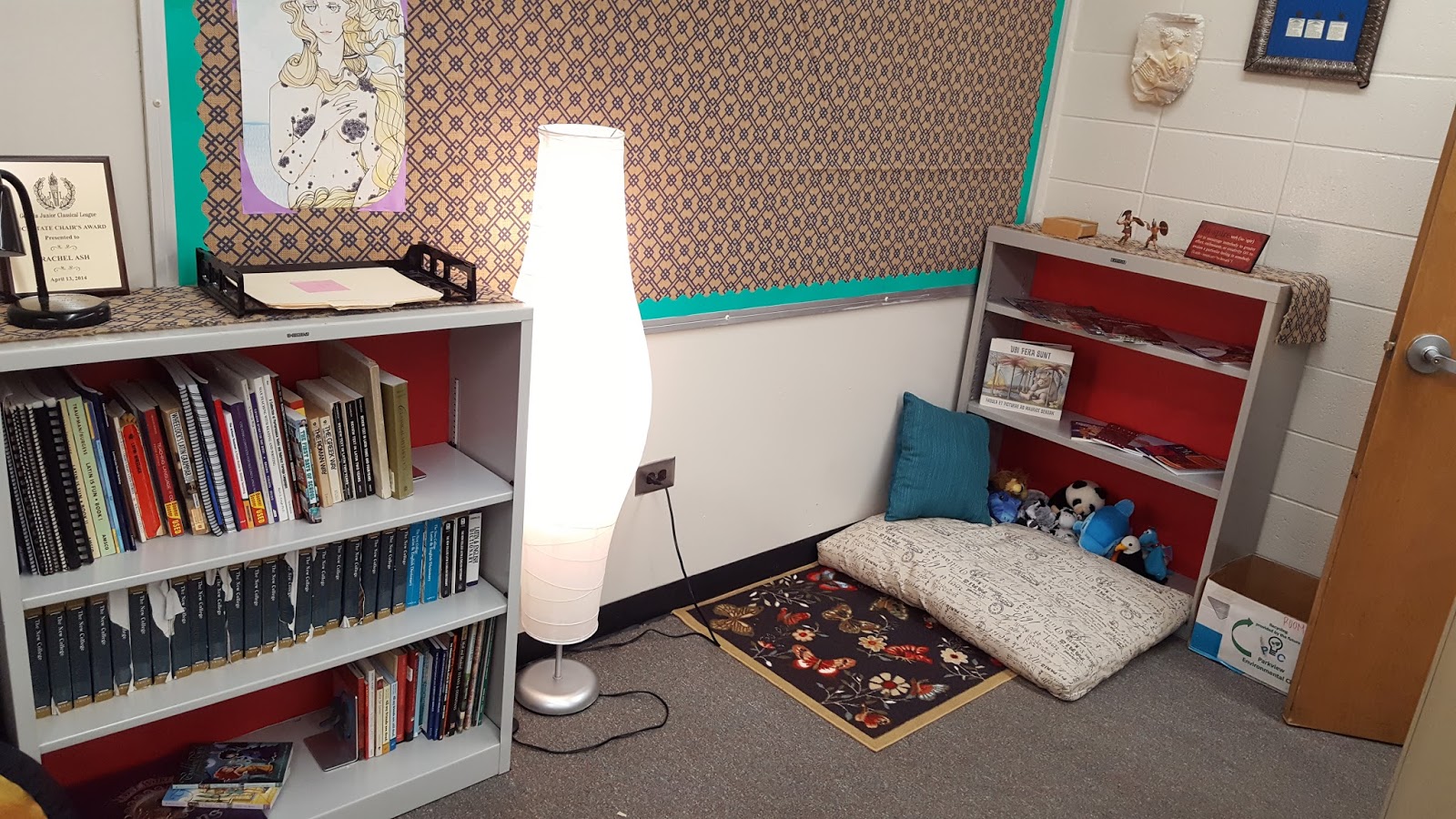
Then I had a sudden inspiration from the huge amount of home decor I've been researching on my down time (I am slowly fixing my fixer-upper home): much of the cookie-cutter effect was coming from the bookshelves, which were clearly collected at random. I had already separated them by type (the wooden bookshelf is near the wooden cabinet and the two metal bookshelves are around the reading nook), but they needed something more intentional. So I removed the shelves and papered the backs of the cases!
Red paper makes the case interesting.

It makes a world of difference. I was going to have to remove one shelf in order to fix it anyway; I can't stand a crooked shelf. So I just removed all the shelves and got the butcher paper that my school provides for our bulletin boards and taped it inside. My gray metal shelves now look like a set, and my wooden shelf seems like it fits with the room.

I also warmed up the room by getting some neat printed burlap to go on the bulletin board (I thought it would wear well and wouldn't be damaged by staples and push pins) and over the tops of the shelves to unify them.

The wooden shelf is my supply/student center shelf. This is an idea I got from Miriam--I had long kept a location for pencils and cobbled a location for loose-leaf paper students could use, but now it's a purposeful space with paper, pencils, erasers, staples, paperclips, tape, and a three-hole punch, plus anything else I find in my stores that I don't want to keep (right now it's a couple of folders, dividers, and plastic paper sleeves). Students are allowed to take items from that space any time they need anything, which does two things: lessens classroom interruptions and reduces embarrassment for students living in poverty. I also have my classroom supplies stored in that bookcase in see-through tubs (another idea taken from Miriam), so whenever we need markers or scissors or anything else, I can ask students to grab items without having to open my cabinet. The lumpy bag in the picture, because I feel the need to explain it, contains t-shirt rags that I give students as dry-erase markers. I like them better than paper towels because I just have to take them home and wash them, then we can reuse them.

The pillows and rug are from Ross (total $35) and the lamp is
from Ikea ($15). An inviting reading space? Priceless.
The two metal shelves hold books for reading and Latin dictionaries. I really wanted to create a space that emphasized reading and also doubled as a safe space for students who are having a really rough day, so I got a rug, large pillow (technically a dog bed--but it's just a large pillow), and decorative pillow to make the area cozy. The bottom shelf near the reading nook is filled with stuffed animals that we can use in stories or students can grab as comfort items if they like. Eventually (my plan is to do this by the beginning of next week) I will add descriptions of the five Latin novellas I currently have access to (I know more are coming out!) on the bulletin board near that space and cement the reading focus.
You can see the reading selection
as it currently stands.

I got to decorate the rest of the room with my students' gifts and projects, and I think it looks amazing. Han Solo even has a convenient corner by my desk that keeps him out of the way and less likely to be damaged. The last thing that needed sprucing up was my whiteboard, which is old and really shows its shabbiness near the top--so I covered the top edge with the same trim I used on my bulletin board.
I left one wall blank--it will be my word wall. Maybe I'll post on that once I have it figured out. I plan to use an idea from Miriam (organize new vocabulary according to question words) and an idea from Traci Dougherty (set up my Latin II vocabulary on the back of my Latin III vocabulary so I can just flip the words over between classes) to make it work.

This is the most I've ever felt my classroom to feel like my own space, and I am excited to share it with my students.

Thursday, October 1, 2015

Everyone needs a little R, R, and R

I am very excited to write this post. This is something that I've been working on since we decided to switch to Standards Based Grading: R, R, and R, or, Review, Reach, and Relax.

My original idea was that every once in a while, we'd give kids a chance to get some review, do some extra work that they needed or wanted, and connect with each other in a way they may otherwise not. Since then, we've all been working on ways to make this work well inside a classroom.

What is it?

What it isn't:

  • a free day
  • a day to work on other classes' work
  • a day to check out
  • a sleeping day

What it is:

  • an opportunity to get extra work and prove proficiency
  • an opportunity to make up missing work
  • an opportunity to get tutoring
  • an opportunity to go beyond requirements and prove proficiency
  • a brain break

Set Up:

We began by creating a document with each standard at the top of a page. Then, as we go through activities and content, we add possible review, and reach activities to help students demonstrate proficiency. Here's the Latin I list of activities.


For relaxing activities, we all offer whatever we have. Rachel has more games than I, but what I offer is: card games (regular cards and Crazy 8s), various puzzles, the lego Minotaur game, or books in Latin, on history, and on culture to read. I am trying to expand this whenever I stop by the dollar store or Target and look at the simple game and puzzles they have. I also bring in books, and am looking at games made for Latin as well.

How it works in real time:

We've so far done this two ways. Rachel gave an entire day to Latin II to work and I gave half a day to Latin I. I'm breaking these down a few ways: procedure, observations, changes.

Latin II - Full Day

Procedure

Rachel and I posted all the standards we had activities for on the board and asked students to check their grades. If they had less than an 85% proficiency rating overall, they were required to work to bring up this grade. If they had better than an 85% proficiency rating overall, they could choose to better their grade or relax with some activities. 

Observations

These are observations of my own:
  • Most, if not all students met the requirements.
  • Because of their grades, few students chose to better their grade.
  • Students chose a brain break and really got into it, making for a great bonding experience
  • Because of the variety of activities, everyone had an opportunity to do something.
  • Students seemed to appreciate the opportunity, and were very open to this new way of doing this.

Changes

Rachel and I discussed a few things and I am making these changes for next time.
  • More activity options for each standard
  • More relax activities to make smaller groupings
  • More time between R, R, and R days instead of the planned once every two weeks.
  • Take students to a computer lab and go over how Active Grade specifically works so that they can use it properly and not just as a "viewing" of their grades.

Latin I - Half a period

Procedure

We began our day with a review of a story we'd read. I was out the previous day and so this was a great way for me to see if students understood. Then, I explained R, R, and R day and my requirements. The main difference here is that I did not offer all standards or activities and I added a requirement. Students must have a proficiency grade of 85% overall and if they had a 0 or 1 in any standard (50-60%), they had to work on that standard, or a similar one. If they met both requirements, they could better their grade, or choose a relaxing activity. The other difference is that, in these classes, I did review grades and pulled students who were missing grades and asked them to complete an assignment.

Observations

  • Most students met at least one requirement, if not both.
  • Students were very open to completing or re-doing assignments, more than I've seen in the past where make up work or tutoring is extra and outside of class.
  • Students found assignments easy to complete quickly.
  • Students chose a brain break and really got into it, making for a great bonding experience.
  • Because of the variety of opportunities, everyone had an opportunity to do something.
  • Students seemed to appreciate the opportunity, and were very open to this new way of doing this.
  • Half a period seemed like an appropriate amount of time to do this in for Latin I.

Changes

These are changes that I either wanted to do this time, but couldn't, or things that I noticed as the day went on. Between the Latin II day and the Latin I day, I did have time to bring in a few more books, Crazy 8s, and a new puzzle, so I even could implement the smaller group change.
  • Take students to a computer lab to go over Active Grade so they feel more comfortable using it.
  • Schedule another R, R, and R day in 2 weeks or so. 

Final Thoughts

I am really happy with this activity. I think, after doing it twice, and typing up this post, that it serves a lot of great purposes. My hope is that the more we do this, the more benefit the kids get. 
  1. Allows me to check in with students
  2. Allows students to really understand grades and proficiency levels
  3. Allows students to have a brain break.


Saturday, August 8, 2015

Making the most of my classroom

This year, I am starting out at a new school after 5 1/2 years in a single school. This pre-planning week has been a whirlwind of information and names (which I'm going to get down, I swear). This week, also, has been very reflective for me on how I'm going to make this new classroom mine. It is very different from the classroom I had at my old school and I want it to reflect so much; not just what I'm teaching, but also who I am as a teacher, who they are as students, our school, and I still want it to be useful to them.

I spent a good deal of my summer looking at ways to make my room visually appealing and organised while keeping in the back of my mind my goals for making my room useful to my students, especially as I continue with my colleagues into the world of untextbooking. Here is what I've come up with:


My Game Station

  1. Game Station - This is a brand new idea I'm trying out this year. We all hear about things like remediation, differentiation, review, etc. I've spent years searching for a way to make all of these easier in my classroom. Since we are also trying out Standards Based Grading this year, I thought of this new way to do all these things, while still giving kids a choice.

    In the game station, I've included culture books in English, books in Latin, card games, a board game (although I want more), and vocabulary books. When we have "remediation days" (I'm playing with names....) students will choose to work on a standard, for which I've set up groups and activities or, if they and I are happy with their proficiency grades, they may choose an activity from the game station (more to come in an SBG post). My goal is to keep students focused and learning, and allow students to improve proficiency in the standards, while still allowing some freedom and options for those who are happy or who get done early. The game station might also be used on substitute days, or when a student finishes a test early.
  2. Student Supply Center - I've done this for years, but this year I'm expanding it a bit more. A few months ago, I came across this list, and it validated my thoughts on my supply center. I don't know what my kids walk into my room with. Some have lots of money, some participate in extra curriculars, some are failing half their classes, etc. I want to do what I can to make my classroom a safe place. Further, I want the focus in my room to be on Latin, not whether or not Johnny has a blank sheet of paper or Misty has a pencil.

    I don't tape big objects to my pencils or stamp my paper with "property of" stamps. My supplies are free and clear. They have signs that say "take one". They also have signs that say, "provide one if you can." I've done a student supply center for years and I've found that it is one of the easiest ways to foster a sense of community and good will. Just as there are kids who have no paper ever, there are kids who have an over abundance of paper. They will donate it if they can. Students leave pencils behind all the time. My students know that if they do that, the pencils and pens will go straight to the supply center for them or someone else to use. This year, I expanded the center to include a student stapler, a hole punch, and sticky notes. It has always had, and continues to have, paper, pencils, pens, highlighters, and index cards. 
    Student Supply Center


    I know this topic can be controversial to some people. Students need to learn to be prepared. Students will take advantage. Teachers don't have a lot of money to spend on this. These are all true to varying extents. Sometimes kids do take advantage; and sometimes, taking advantage is a cry for help. Just because Misty has taken a pencil every day this week, doesn't mean she is lazy or forgetful. It might mean that she really truly has none, or that she goes home and her little siblings need one. Students do need to learn responsibility. I try to model that through caring.
  3. Posters
  4. Motivational Posters - I chose these carefully this year. I didn't want them  to motivate kids so much in Latin, but to motivate them to enjoy life and be proud of themselves. poster envy has lots of great posters for around $8 each. The two I've purchased so far say two of my favourite things: "Everybody is a genius. But if you judge a fish by its ability to climb a tree, it will live its whole life believing it is stupid." AND "Life is about using the whole box of crayons." I think the things we choose to put up on our walls greatly influence our kids. I know that I, as a student, always looked around and see how a teacher decorated his/her walls. Was his/her focus on getting my to turn in homework and walk in with a smile, no matter what? Or, was his/her focus on helping me feel better about myself, be confident, and enjoy school?
  5. Bulletin Board - I was blessed this year with two bulletin boards. It does take up valuable wall space, so I decided to do as much as I could to make the most out of it. One board I dedicated to student work. I went a little pinterest crazy and painted clothespins to hang up and pin student work up because I hate having too many staples in a bulletin board. The other I divided into three sections, only one of which I'm focusing on in this post: first, a wall of victory, second, a Junior Classical League section, and third, a place for school news and announcements. 
    The orange is our wall of victory


    This will be my second year implementing a wall of victory. I had great success last year. The wall of victory is designed by me, but filled by students, and is a place for them to proclaim their victories. Last year I had everything from high test scores, first occurrences of Bs and As, finally understanding certain topics, sports victories, vacations, and even thank yous. Thank yous for supplies, food, and even for telling a kid his shoe was untied. These victories may be huge or they may be small. They may be school related or personal. I don't require names. What I've found from this is that it increases morale in the room tenfold and kids love reading about each other. I also get to know my kids more and, on some occasions, pull information from that to email parents or build stories in class.
  6. Word Wall - Unfortunately I do not have any pictures of this yet, but when I do, I plan to make a whole post on them. My word wall may be one of the most important visual features of my room this year. In the past, I've organised the word wall alphabetically, and by theme. This year, I'm doing it completely differently. I'm organising it by question word, but more on that in a later post. No matter how you organise your word wall, no matter what language you teach, no matter what subject you teacher, I encourage everyone to have a word wall. There were countless times as a student when I was writing on a test, or an essay and I couldn't recall a certain word. My teachers were, mostly forgiving if I got it slightly wrong, but my stress level sky rocketed when that happened and I am most certain that my test or my essay suffered for it. As a Latin teacher, my goal is to get kids communicating, not hung up on a word, so I have a word wall. I really do want a separate post on this, and since I don't have pictures yet, here are some ideas for a word wall and its organisation:
  • organise words by part of speech
  • colour code words by part of speech
  • organise words by unit, or lesson
  • have students write words on paper for posting, instead of you doing it
  • have students draw pictures to represent each word for posting
  • take words down that you are 100% sure all students know
  • update it daily/weekly
  • have a student update it for you
  • use the wall to create quick review lessons or activities

I am writing this post because I believe classroom organistation is important. I often joke that I got my organisation from my elementary school mother because I really do like things colour coded, symmetrical, and pretty, and I do tend to make Pinterest my best friend, technologically speaking. This year I've really tried to hone my skills and make my room truly useful, not just pretty. How do you organise your room? Go sit in a student's chair and see what is really visible from it. Are the things you want them to see actually easy to see and read? What message do you send your kids about your class by the things you choose do show?


Friday, January 27, 2012

Interactive Display: Make your wall or bulletin board a discussion board

So this year as I prepared to put up my usual decorations in my classroom (about which I was unusually ecstatic, but that's another story), I had a sudden, simple inspiration.

In my second year teaching, desperately jealous of the festive, fun rooms my Spanish-teaching friends got to set up for their students, I went into school a week early and began creating.  I created inspirational posters in Latin, Latin question posters to help me teach class in a conversational way, and large cutout versions of the main characters from our textbook (if you are frustrated now because you think you can't draw well enough to do this sort of thing on your own--that's what projectors are for!  I traced every image).

Since that year, every year, I have glued or taped these characters to my wall as a traditional start to my school year.  And every year I try to arrange them in interesting ways, to spark discussion among my students (a popular discussion centers annually around whether the mother is having an affair with the cook!).

This year, as I was hanging them and deciding how best to cause soap-operatic speculation, I realized that I have been sitting on an inspirational gold-mine for many years and never realized it.  My students love to comment on these images.  Why not have them do it in writing?  In a very direct way?

Using only the latest in technology, I quickly grabbed everything I needed and set to work.  Before long, there was also a pad of post-it notes taped to the wall beside my little Roman family.

Characters from the textbook--covered in Latin comments!
I proudly introduced this innovation to my students on the first day of school.  They looked terrified.  They didn't know how to write in Latin yet, so this seemed very much beyond them.  I decided to wait and remind them later.

Around two weeks later, I mentioned the board again.  By this point they had a working vocabulary of over 40 words, so it was no longer a scary prospect, and I had made class a safe place to experiment with language.  No one moved at first, but by the end of the week, I had three post-it-notes safely stuck to various characters.

As the month progressed, I got new notes pretty regularly, and students liked to read the new notes that showed up there between classes.  The notes got progressively more intricate and used better grammar, but I still really enjoy the earliest notes best.

Some early notes inflicting violence with the only violent words they know how to use:
eat and cook.  Oh, and explode.  Because who doesn't need that word in his or her daily life?
Next year, I will be doing this again.  But I think I will rotate the wall more often; interest fell away after about a month.

I can't wait to see what my new students will write and think, in Latin, outside of class proper, voluntarily.
Sometimes I think I've created a monster.  But it's a Latin-loving monster, so I enjoy it.

Friday, January 6, 2012

Learning about Learning Centers


I'm experimenting in my class.  Again.  I've experimented on my poor students since that fateful first day when I sat uncomfortably on a teacher's stool and stared awkwardly at my class for a full fifteen minutes because I had no realistic idea what 90 minutes meant in actual teaching time.  Even on that first day I had experimented: I had not taught my students the way I had been taught; we started the first day of school with stick figures decorating the marker board (newly installed--the room still smelled like chalk!) and talking about "reading" Latin instead of "memorizing" it.  Then I ran out of steam and sat on a stool, and stared at my students and they stared at me, and I figured I needed to come up with something more and better.

My newest experiment is actually nothing new in terms of the holistic teaching world.  I had heard of learning centers here and there and even met a Latin teacher who uses them in her class a few years ago, which was really interesting, but so foreign that I had no idea how I could do such a thing in my own classroom.  It wasn't until two years ago when I was teaching at a small private school in Tulsa, which ranges from pre-k to 12th grade, that I became genuinely positive that I need learning centers in my own class.  I was exposed to some great teaching at that school and surrounded by people who were passionate about the school and its children. I was given the unique chance to talk in detail to teachers who had learning centers, to find out the research and philosophy behind them, and to see them in action.

That was two years ago.  Why did it take me so long to start experimenting?  Those teachers were elementary school teachers and I teach 7th-12th graders.  Figuring out how to create a similar environment in my own class without making my students feel "babied" was and is a huge concern.

There were other concerns, among them how to create flow between the tables, how much work will it be to create activities for each table, what kind of activities are conducive to that setting, etc.  Some of my concerns have been resolved, others are still works in progress, as is the technique itself.

I have used learning centers in my room around five times now, and I find positive and negative points to it.

Positive:

  • There is room flow.  I have arranged things so my students end up with a different group of people at every table so they don't get to stay just in their "safe" crowds.  
  • There is movement.  I personally cannot concentrate without pacing or moving at least a little, and I am never surprised to find that students feel the same way.
  • We can do several activities at once.  Sometimes I want to approach a concept from a certain number of angles, but doing those activities as a class is difficult, because they start to feel repetitive and often are small-group activities, which means I'd have to organize my students into those groups anyway.  In this setting, they're in groups and they are moving around, so those concerns diminish.
  • I can get closer to one-on-one learning.  If I set a certain table aside to be one that I use to talk to my students about a new concept face-to-face, I'm now explaining to five students at a time instead of 30.  That can make an explanation that might take 20-30 minutes only take 5 and offer students the chance to ask detailed questions in a less threatening environment.


Negative:

  • It seems chaotic on the surface.  This is not so much a concern for me, because I understand that sometimes things that seem chaotic have organization to them.  That said, some people face administration who judges a loud classroom to be a bad one before looking for the method to the madness.
  • I have trouble balancing the different learning stations.  I am so new to this, and there's not a lot out there for me to easily reference, that my activities are not evenly matched in terms of time.  There is always one or two tables finished very quickly, around two that are in the middle, and two that take much longer than all the others.  This does not create the smooth transition I want for my classroom.
  • I have no idea how to approach grading it.  Currently I'm giving completion grades, which works for most of my students.  But that seems like it's cheapening the point of the arrangement, which is, for me, mostly experiential.  I have students doing activities I think will make Latin easier for them to understand, or ones that cause them to reread stories for more detail.  Giving a grade seems to make it more about the work and less about the learning.
  • Some students are not taking it seriously.  This is only around five students, all in the same class, probably influencing each other.  But it's the only reason I'm even considering what to do about grading it--it was the only way I could get them to take it seriously.  
I have a lot to learn about this concept, but I like it, and most of the feedback from students has been positive.  Those who are very dependent on their friends for support are less happy with it, but that is a smaller minority than I thought it would be going in, probably because they are changing company every 10 minutes or so (so if they don't like someone, they'll sit with someone else soon after).  

Will this latest experiment be successful?  I don't know yet, but I will let you know.  For me, at the moment, the positive is outweighing the negative, so I'll continue to try it out.