Showing posts with label google 80/20. Show all posts

Saturday, June 4, 2016

This Year's Google 80/20 Project

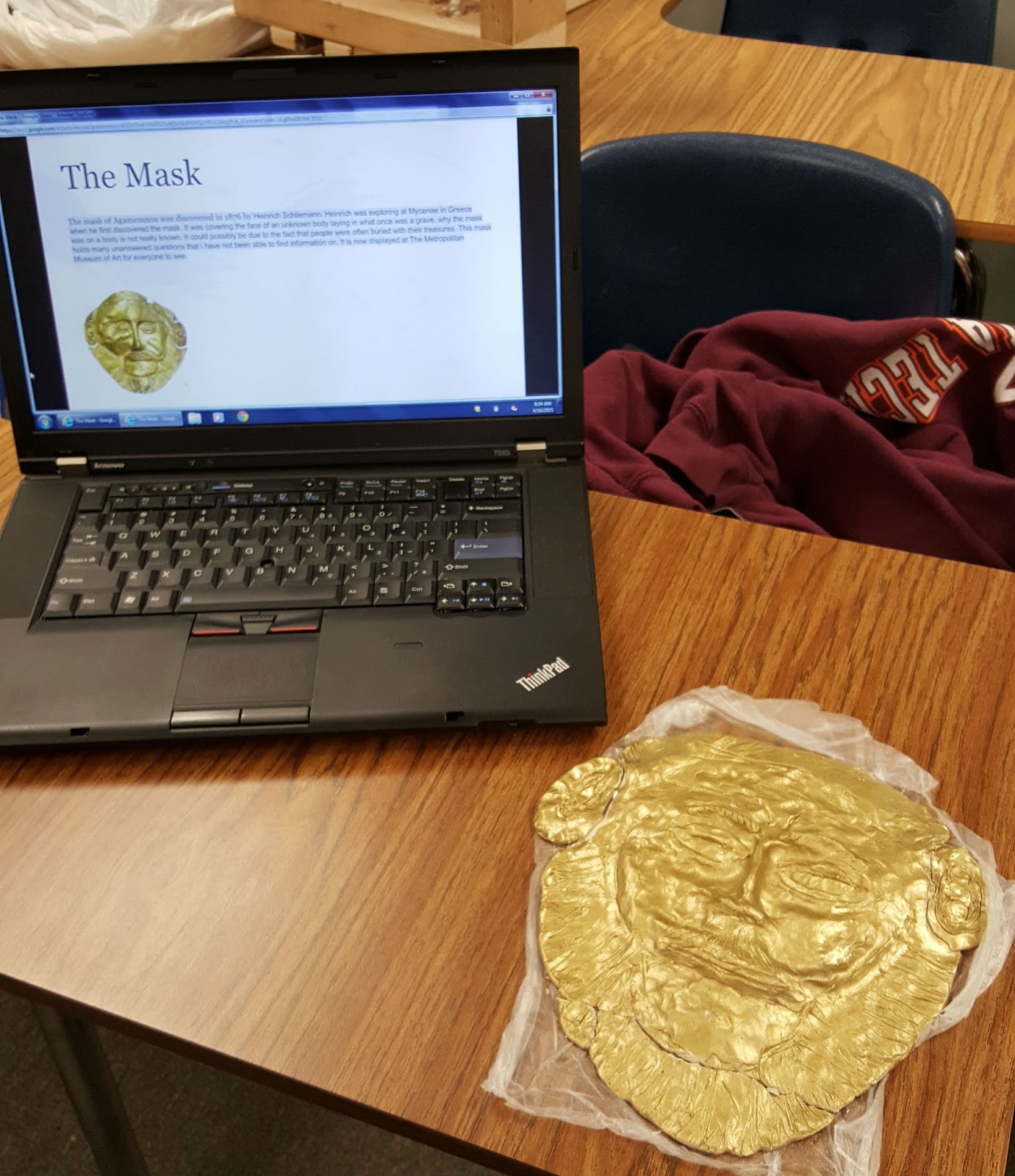
A student was fascinated by Agamemnon's mask and
chose to recreate it in ceramic.
I think I've talked about my love for Google before. That hasn't changed. I hope to be a high-ranking officer in the Google army when it gains sentience and takes over the world more effectively, efficiently, and effervescently than Skynet ever dreamed, with a cheerful Google Doodle to commemorate the event.

Part of Google's success is its business model. Google dictates only 80% of its employees' time, and leaves 20% of their work time free for employees to work on any project they are interested in--as long as it can be tied back into the company. That is where most of the April Fool's Day jokes come from, and it is the source of the innovation and creativity of the company. Once Miriam and I heard about that model, we immediately wondered how to bring it into our classrooms. We haven't honestly finished figuring it out (Miriam started two years ago and I started last year), but I thought an update is due. We did some good things this year and have already started discussing what we want to do next year.

I thought it would be easiest if I broke down what I did last year and this year by topic, then discuss what Miriam and I are thinking about for next year.

Introducing the Project
This year, I handed out this paper to each student that outlined the project, my expectations for the project, and focused in particular on the idea that it needed to be an actual product, not a poster or a powerpoint presentation, plus my expectation that the product would reflect real research (not Google Images) and would have taken ten hours to produce (in specific, it would show that they had not wasted the ten hours of instructional time I had given them to work on these).

There were several differences between last year's handout and this year's handout:
One student created constellations that could be viewed
as just stars in the dark (see inset image).
A student recreated the Parthenon and included a scale model
of the statue of Athena Parthenos, which can't be seen in
this picture, unfortunately.
  • I eliminated mentors. I love the idea of students learning how to seek expertise outside Google, and was committed to helping students find mentors in their topics of choice, but in a regular school class, without a school initiative, it just proved to be too difficult to incorporate expert help for every student in six different classes.
  • I replaced discussion posts with conference sessions. Last year I required a discussion post (on our school's learning management system, of which we were required to show use) every week to update me on students' progress, thoughts, and needs regarding the project. Students were unable to think of new things to write each week, so I ended up coming up with topics for each post, and even then it was not only a burden on them but on me, who had to read 180 discussion posts, make thoughtful answers, and grade them for following the requirements I had set--every week. This year I conferenced with each group, sitting with them, asking the questions I needed answered to be sure they were making progress, answering their questions directly, and checking their resources to make sure they are authentically related to ancient Rome and Greece.
  • I added a conclusive video requirement. I decided last year that I preferred to have students present their projects in a gallery, like a mini science fair, rather than formal presentations. The format left something to be desired, though, that presentations would have included: a formal discussion of the research each student/group undertook, how the research related to the products, and whether they found their ventures successful. So I added a video, and wherever a product was placed, I put a laptop with headphones, so the videos could be viewed by anyone.
During the Project
A student worked to recreate the Antikythera device. He
had planned to use a 3-D printer, but the printer broke
down. He was able to show me his plans and adjustments
to incorporate the modern understanding of planetary
movement.
Laptops
Last year I hosted each "20% day" in the computer lab so students would have easy access to information for research. This became an issue later in the project when fewer and fewer students needed computers to complete their projects, and I was afraid to allow students to bring art supplies, etc., to the labs, so many students just did nothing during those days.

Thankfully, my school got laptop carts this year and I was able to check one out each Friday. The cart does not contain enough computers for my classes (only 16 per cart), but since most students were working together in small groups, that issue was easily resolved: only one computer per group.

A student studied ancient music and musical instruments.
She created a working pipe!
Groups who were doing something creative were able to bring supplies on Fridays, because we worked in my room instead of the computer lab. Students filming were able to film. Basically, this allowed students to complete most of their projects in class.

Proposals
Each group turned in a proposal for their project that included their topic of choice, planned product, and a timeline for each week in class. For some groups this took several tries; I would get their proposal, give them a correction (often "Timeline doesn't mean due date--it means everything you are doing and when between now and the due date"), and have them fix it and resubmit.

This process helped clarify for students what steps they would need to take to complete their projects on time and what expenditures might crop up (something many students don't think about).

It also helped me intervene when students were clearly headed in the wrong direction (most commonly when students were mistaking modern things for ancient things--like food).

A group worked to recreate ancient foods for their classmates.
Conferences
Each Friday I met with around half of the groups, and kept track so I would be sure to be meeting with everyone in turn. I used their proposals to remind myself what they were working on and where they should be by that point. The proposals were really just a guide; sometimes the projects took an unexpected direction that required a completely new timeline.

The conferences, like the proposals, gave me the chance not only to spur students on who were dragging their feet on their projects, but also to further check for misunderstandings or false research--this has been a good opportunity to teach students about websites as resources and how to decide whether a resource is fallacious or not. Romans and Greeks are very popular and there are innumerable websites dedicated to false information about both.

The Due Date
The day the project was due, I pushed all the desks in my room against the walls to make a sort of gallery where students could place their projects and the laptops showing their videos. After they set up, I roamed the room watching videos and grading projects with this rubric.

A couple of students were interested in ancient
surgery and decided to recreate one of the
tools. They took progressive images to show
what the surgery would have looked like and
posted on tumblr.
There were mostly projects that blew me away, but there were some that, even with conferences and oversight and constant reminders of what I was expecting, produced items copied from a Google Image, or from their own conception of what Romans or Greeks were like.

For Next Year
Overall I think that it's been a good thing to let students explore their own interests. That said, there are several things that Miriam and I have been discussing for next year.

  • More due dates along the way. I already had students turning in proposals, but there are other items we could have students create along the way to make sure they are progressing toward a meaningful project, like a bibliography of sources (solving the problem of students still getting around me and using Google images as a source).
  • Focus the project around Products, Practices, and Perspectives. This would help students think about what culture is and how it relates to the Romans and ourselves. This would also help them figure out what they could create as a result of their research and how it could be considered a true product (I outlaw powerpoints, posters, and speeches because they are used to slapping those together for everything and can do it with minimal engagement).
  • A couple of young men composed music dedicated to the
    gods; one also composed music to accompany our book!
  • Focus the project on a problem, and how to solve it. This is Miriam's idea, and I'm really excited about it. Students would have to research actual problems the Romans faced and create solutions using only materials and resources that would have been available to the Romans. This seems like it would require meaningful research and creativity just to start
I think the projects have been very good, overall, but I don't think I've figured out how to do this project very well yet and I am continuing to work towards a goal of perfect student engagement and valuable products.

I'll report in next year with changes to the project and results!

Wednesday, May 14, 2014

Google 80/20 Project - Plus Deltas

I've been working on my follow-up to the Google 80/20 project that I piloted with my IIIs and IVs this year. I had typed up an intermediate post, but held off for all the reasons Rachel stated in her previous post as well as a few personal issues that got in our way (AKA an acute concussion and a broken wrist). My classes and I just finished our presentations and I'd like to do two more posts. This one, where I address some questions and discuss my observations (and whether they are a + or a δ) and conclusions and another when I discuss the kids' feedback.

Observations

  • The students really enjoyed being able to choose what they wanted to study. They all chose topics that meant a lot to them. This made the entire process more enjoyable. +
  • Many students felt that they had all the time in the world and were caught doing other work more than once. δ
  • Students chose whatever they wanted, but some failed to connect it to Latin. δ
  • Some students took seemingly odd topics and managed to use Roman culture and myth to establish a connection. This was quite unexpected and interesting. +
  • Students felt held back by previously expressed ideas (from years of schooling) and felt they HAD to do a presentation visual (PowerPoint; Prezi; etc.) δ
  • Students turned in their correspondence with their CCs, but didn't use their CC for advice or peer editing. δ
  • Students, again I suspect, from years of schooling fell into this "presentational" mode where they stood in front of the class and explained rather than discussed. δ
  • It was easy to see who was comfortable with the free discussion. Students really worked to help each other during the final "presentation" asking clarifying questions. +
  • I got a clear view of what interests students. These are things I can use next year for instruction. +
 + Conclusions
A few things are clear to me here. If (and I think I will) I do this activity again, I will keep as much freedom as possible. Students who are interested, as the latest FL research suggests, do good work. I would be hesitant to place restrictions on topics, although I feel some may be a good idea, just because the connections some of the kids made were so unexpected and good. I would hate to hinder that. I will be interested to see student responses.

I think I will want to do this earlier in the year. Some of the data  I took in about who was comfortable discussing would be useful for further instruction. I also think it may be beneficial, if done earlier in the year, to tie an assessment to it (using student questions and feedback).

 δ Conclusions
There are some things I'd definitely change. Most of these changes are based on the deltas I noticed. Once I get student surveys in, this list may be added to or change, but I definitely think I'll do these things next year. 
  1. A set timeline with due dates for rough drafts and peer editing - I hope this would combat the feeling of having endless time and help students use each other as resources.
  2. Ban presentational programs - I am, honestly, so tired of PPT and prezi. Next year I think I will just require student to have a different visual. 
  3. Require students to discuss Roman cultural perspectives, products, or practices. - I am on the fence with this one. Perhaps I would require this for younger groups. I want them to have freedom, but I want to make it useful to our class and avoid a "book report" on a topic. 
  4. I would change the set up of the classroom for this - I would put the desks in a giant circle or perhaps in small groups while I floated between them. I would hope that this would encourage more discussion. 
Student surveys are coming and will, more than likely, change some of my conclusions. I will update more once they come in. 

Friday, January 10, 2014

80% of me, 20% of you - adapting Google's 20% time idea to the classroom

For a while both Rachel and I have wanted to try out Google's idea of 20% innovation time in our classrooms. We did the research, but were waiting for a final push to try it out. Between frustration with textbooks, testing, and what we were able to look at this past fall at the American Council on the Teaching of Foreign Language's 2013 conference, we have finally decided to give it a try.

This Spring, I am piloting my version of the 80/20 project with my Latin IIIs, IV, and AP students. I will be posting, hopefully, regularly on the process and the reviews. I intend to have students fill out surveys every few weeks to check in on their progress, but also get their feedback on the project itself. In this post, I'm going to set forward the premise of the project and talk about my initial reactions.

This link goes to my outline of the project. Students are being given an entire semester worth of 20% of time to work on this project and I will be using it as half of their final exam (we have to give performance exams each semester measuring speaking and writing progress). I don't want to repeat what is in the document, so I will try and address some of the questions they asked me instead while we went over it:

Frequently Asked Questions by Students
  1. What will we be turning in?Students will be turning in almost a portfolio of their project. They will need to have a presentation to share, a physical product to show, notes, cited resources, and their correspondence with their CC. I will use all of these elements to grade them using the rubric in the link. 
  2. How long does our correspondence have to be? I do not expect, especially in the beginning, long correspondence each time. Some times will be longer than others. In the beginning, they will introduce themselves and their ideas and as they research, their ability to discuss should grow (ergo, they will be making progress in their writing)
  3. So, the topics must relate to Rome? Not necessarily. The topics must relate to our classroom. For example, a student may take a survey of the class and find out their favourite movies/shows/music/etc. Then, they may look to see how much of an influence Roman culture, history, and language have in our modern media. Another student may be interested in cooking. They may look into Ancient recipes, or perhaps look to see how differently we do things or compare health standards or, just for fun, might try to cook modern recipes using only ancient methods. Students may create games for the class to play, videos to watch, etc. 
  4. Why can't we just know the day we're presenting now? I have found that students who know they are going the last day will wait until the last day to be done and, if we have extra time for example on a previous day, they will not be ready and will be upset. By asking each student to be ready the first day, I can go ahead and collect certain aspects (notes and correspondence) and begin building my grade that day. Everyone will have the exact same amount of time to prepare. 
Today I took my students to the lab for their first 20% day. They were given the period to pick a topic and complete their first survey. Below are my observations:
  • Some students will really struggle with the freedom. This is okay, and they need to know that it is okay. I sat with a few students who had no idea where to begin. I asked them what they liked to do or really enjoyed learning about. For the most part the response was, "but there is nothing Roman about..." So, we went over the connection part again. All my students ended up with a topic in the end and a clear connection.
  • I would change my initial survey to include a question about what resources they know they'll need. This will help me create resources more quickly and with more accuracy. 
  • Students were surprisingly excited to find out who their Classroom Comrades were (one of my favourite words, plus the alliteration is magical). They will find out over the weekend and be asked to begin communication ASAP. 
  • The students researched the entire period. Only once did I have to ask a student to focus. Since this project really focuses on their interests and their likes, I think, and hope, it will turn out to be easy work for them.
In my next post, I plan to update you on the progress of the project and take a look at the resources I am providing to my students. Stay tuned!